The Hummingbird program began its development in 2010 as a result of the experience gained in teaching library management systems within the course «Automation of Information Units», part of the Documentation degree program at Complutense University of Madrid (UCM). Based on an analysis of its functionality, the main weaknesses and improvements necessary for a new library management system were identified, incorporating the latest advances in bibliographic catalog syndication and redistribution.

Hummingbird is designed for easy and rapid implementation in libraries and information centers with collections ranging from 1,000 to 700,000 items. The guiding philosophy of the entire project is simple: “made by librarians for librarians,” ensuring adaptability to any type of library. The program is conceived to accommodate future document types and authority formats, offering maximum descriptive capacity inspired by MARC, ISBD, ISAD-G, and ISAAR-CPF standards.
On the other hand, one of the features that distinguish Colibrí from other comprehensive library management systems is that the information is not owned by Colibrí, but by you. This means there are no limits on the import and export of bibliographic records or any data entered by the library. The program does not retain content, fully respecting ownership and the free disposal of such data by your library, offering a level of freedom comparable to any open-source software.
Colibrí is also a pioneer in pre-cataloging processes. In addition to traditional procedures for importing and retrieving bibliographic records via Z39.50 (currently being implemented in development), there are other methods that allow the retrieval of bibliographic records from third-party libraries or bookstores by scanning their commercial UPC barcode. This assists librarians during the initial document analysis.
Another common demand among libraries is the availability of simple cataloging forms tailored to each document type. Colibrí has taken this into account, as a specialized cataloging model saves time and enhances document retrieval capabilities. Thus, it is possible to specialize cataloging for Conference Proceedings, Seminars, Workshops, Audiovisual Materials, Catalogs, Brochures, Photographs, Reports, Legislation, Manuscripts, Maps, Monographs, Reference Works, Periodical Publications, Web Resources, Reprints, and all derived document subtypes.
The future of item location lies in phototopography, and Colibrí has already implemented it. This allows precise tracing of a document’s location—from the building, through the floor, room, shelf, and folder—identifying each element with its corresponding topographic code.
Another advantage of Colibrí is its triple classification system: whether through a multilingual thesaurus with four levels of depth, primary and secondary decimal classification, or semantic tagging, the librarian has the freedom to choose the method that best suits creating access points to the document.
Regarding Colibrí’s graphical interface, it is designed to keep all essential options and functionalities visible at all times, enabling the librarian to perform documentary tasks efficiently. It does not generate pop-ups or new windows with information; instead, Colibrí has fully integrated these elements, avoiding unnecessary distractions and artificial interfaces. Moreover, Colibrí not only integrates the core functions of an ILS but also includes the library’s homepage and direct access to the OPAC, significantly reducing the number of clicks required to reach the catalog and key institutional information.
Colibrí is designed with semantic capabilities. This means that various types of relationships can be established between documents and their authorities, as well as with the labels that classify them. Although not implemented in versions 2.0 and 2.1, this functionality is planned for introduction in version 2.2 with an integrated automatic semantic inference engine within the OPAC.
Web positioning techniques applied to Colibrí enable the description of the library’s homepage and OPAC bibliographic records using diverse metadata, significantly enhancing the institution’s visibility on the web and its retrieval capacity outside it—for example, on Google.
Colibrí is a pioneering program in implementing modernized call numbers with QR codes, meaning that using a code reader or even a simple mobile phone, users can instantly load the web page of the bibliographic record for any book. This allows users to obtain additional information immediately.
Regarding the OPAC interface design, it meets industry standards with a simple and clean appearance. It enables full-text searches, queries by specific fields, filtering of information by document types, authorities, and classification, as well as multiple display modes—gallery, simple, and advanced—ensuring maximum relevance in search results.
Versions
2.1 – 2013-10-21 – [In development]
2.0 – 2013-01-19 – Stable version
1.0 – 2010-10-21 – Base version of the program. Development initiation
System Requirements
- Apache2+ PHP5+ MySQL5+ server (for example, a distribution such as AppServ or XAMPP with basic libraries would enable perfect functionality)
- Multiplatform: Windows, Linux, MacOS
Specifications
- Pre-cataloging Module. The pre-cataloging interface enables immediate retrieval of document information through scanning of its commercial barcode, assignment of the cover image, documentation type, authorities, and topophotographic location.
- Registration Module. Emulation of a library register book containing all pre-cataloged, cataloged, and registered documents. Enables editing of records, cataloging, duplication, deletion, linking, and retrieval of any document.
- Cataloging Module. Allows visualization and cataloging of all document types, relationship of linked records and copies, topophotographic location, automatic signature assignment, and full-text retrieval. The system includes a variable and specialized cataloging method tailored for each document type, fully adapted for exhaustive description.
- Periodicals Module. Catalog of periodical publications, multi-level editing, cataloging of copies, document analysis of articles, journal emptying.
- Authorities Module. Enables comprehensive description of authorities, including personal, corporate, familial, collection, conference, publishing house, geographic, and series entities. The system also allows for the creation of new types of authorities not originally specified.
- Classification Module. Multilevel and multilingual thesaurus, decimal classification, and semantic tagging system.
- Loans and Circulation Module. Designed to manage checkouts, returns, reservations, and verification of circulating items.
- Reports Module. Printing of barcode labels (Code39) and call numbers (with QR code) on standardized label sheets; statistics on fund distribution by document type, status, subject classification, labels, and decimal classification. Also includes reports on user types, subscriptions, current loans, overdue items, and pending reservations.
- DSI Module. Content syndication is applied as the primary method of redistribution according to the query filter established by the administrator. It also provides an alert service via mass email distribution lists for users.
- Configuration Module. Designed to easily modify the entire functionality of the library management system. It allows editing of all user types, authorities, loan policies, periodicity, semantic relationship types, authority functions, conservation states, analysis phases, loan statuses, media types, rights, rights case scenarios, etc. It also includes SEO (Search Engine Optimization) configuration, OPAC page settings, and default values.
- Users and Administrators Module. User and administrator registration, along with configuration of restrictions, functions, and privileges.
- Maintenance Module. Table optimization, defragmentation, repair, reindexing, literacy, signature assignment, and character replacement functions.
- Data Migration Module. Import and export in CSV, SQL, and XML formats (MARC and MARC-XML coming soon).
- OPAC. Online public access catalog with integrated library website. Triple display method. Filtering system based on document type, authority type, authorities, and classification. Includes permalink and QR code link. Enables export of marked records, automatic citations, and references.
Updates in Version 2.1
- Aggregated Collective Catalogs. Retrieval of bibliographic records through content syndication, collective transfer, and querying.
- Z39.50 Protocol. Functions for retrieval and pre-cataloging are integrated.
- Import and export of records in MARC and MARC-XML formats
Updates in version 2.2
- Acquisitions module. It will enable forecasting of documents for acquisition through purchase, donation, or exchange, with corresponding budgetary control, supplier management, receipt, and integration into the collection.
Screenshots
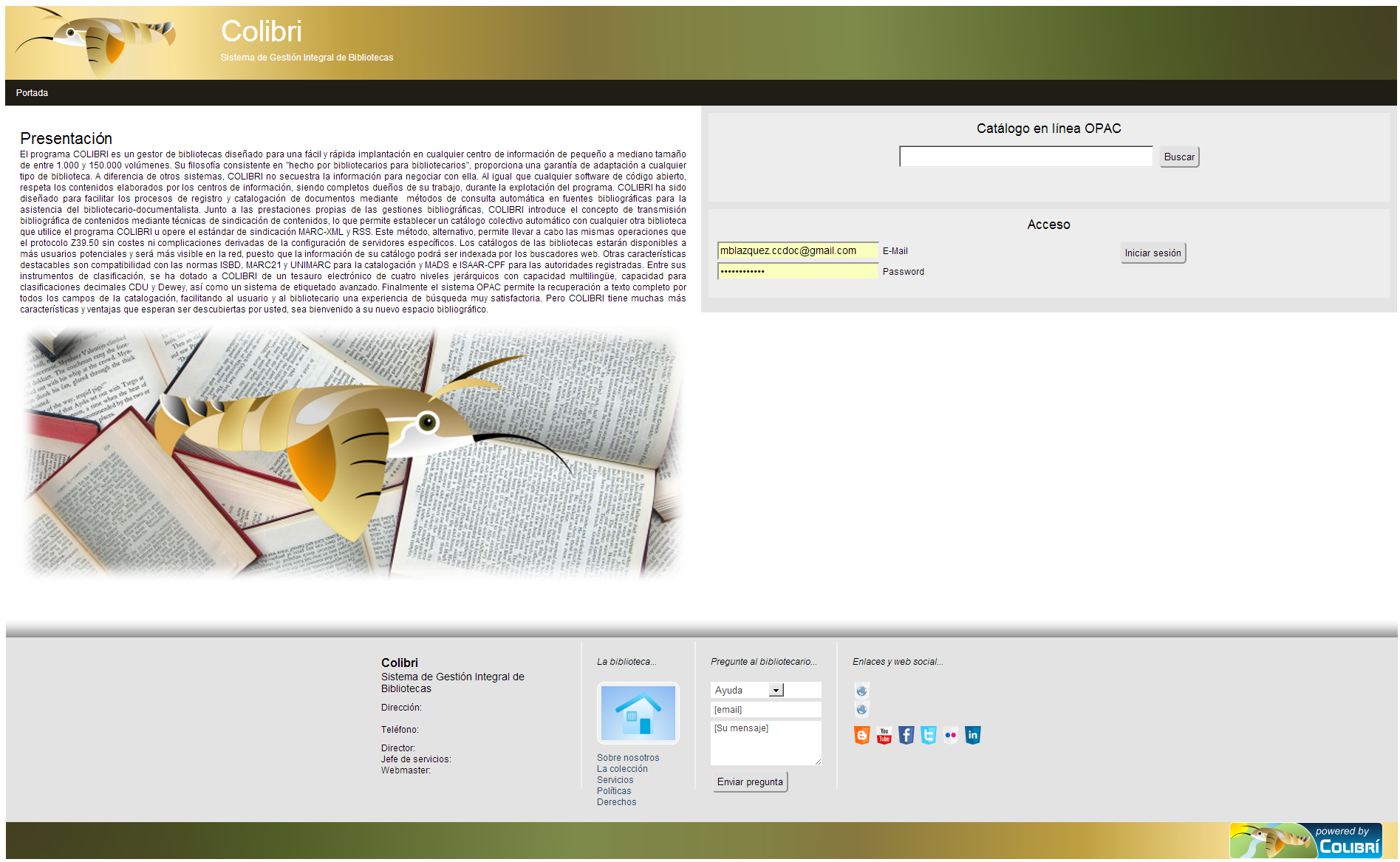
Figure 1. Home screen of the library management system

Figure 2. Simple visualization of the Colibrí OPAC

Figure 3. Gallery view of the Colibrí OPAC

Figure 4. Advanced visualization of the Colibrí OPAC
Videos
Colibrí: Overview of the Application
Review of the modules of the Colibrí library management system. Some screens from the configuration, user and administrator management, maintenance, migration, pre-cataloging, registration, cataloging, authorities, classification, circulation, DSI, and OPAC modules are shown.
Video 1. Overview of the features and functions of the Colibrí ILS
Colibrí: Labeling and Call Number System
The Colibrí library management system has been designed to streamline labeling and call number assignment tasks, enabling any library to generate these elements on standardized label sheets. Additionally, it incorporates innovations in document identification through QR codes embedded in call numbers, facilitating the location, positioning, and referencing of documents. In the video, a user retrieves the permalink URL of the bibliographic record from the library’s OPAC using the document’s call number.
Video 2. Operation of the labeling and call number system
Institutions Using Colibrí
- Instituto Gemológico de Madrid. The library of the Instituto Gemológico de Madrid contains one of Spain’s most important collections in gemology, jewelry, appraisal, and specialized legislation.
- Website: http://www.institutogemologico.es/
- Library portal:
http://www.sync2company.com/igm/黻